Chiang Rai Photoshoot Guide: the White Temple at opening, the Blue Temple, the Black House
Chiang Rai is a quiet provincial town with three of the most photographed buildings in Thailand on its edges — a white temple, a blue one and a house of black timber — and a session here is a route between them, from morning to evening. The order matters more than anywhere else in the north. The White Temple belongs to the first hour after opening, before the glare and the day tours; the Blue Temple and the Black House hold up later in the day; the hills and the rivers take the afternoon and the end of it. What spoils Chiang Rai is the White Temple at midday, when the white stucco and mirrored glass throw back a light no face survives, and the haze months, when the mountains are simply not there.
Wat Rong Khun, the White Temple, at opening
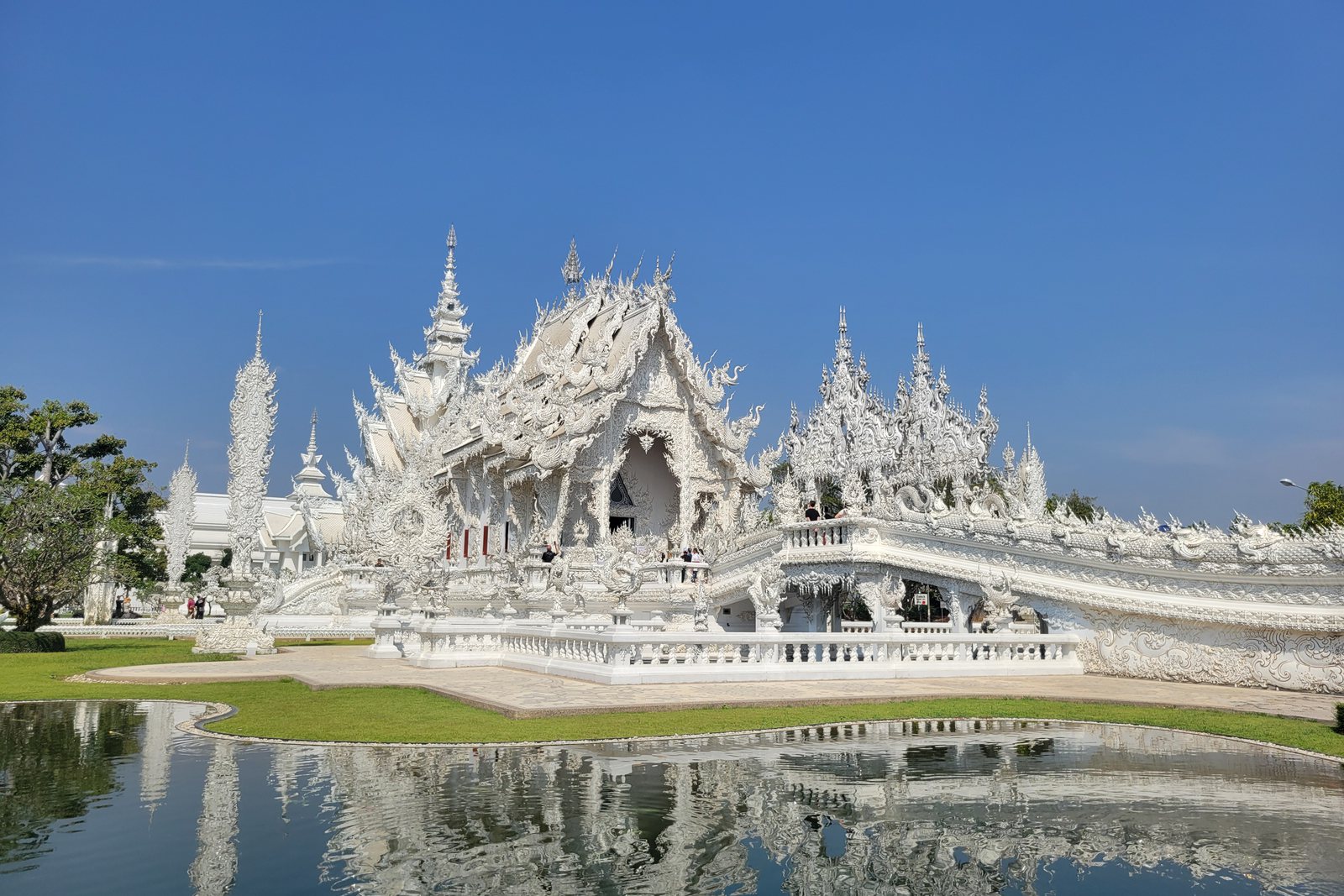
Wat Rong Khun lies about 13 kilometres south of town, on the road from Chiang Mai. It is the work of the artist Chalermchai, who began rebuilding it in 1997 and expects the building to go on for decades: white stucco and mirrored glass above a pond, a bridge over a sea of reaching hands, spires that catch the sun from every side. Nothing else in Thailand looks like it, and nothing else is quite so hard on a camera at noon.
Opening time is the sensible hour for two reasons. The low sun gives the white some shape — shadow in the carving, a glow in the glass instead of glare — and the day tours from Chiang Mai, which make a drive of about three hours, often more, have not arrived yet. Check the opening hours before you go; foreign visitors pay an entrance fee. The best frames are from the grounds and the edge of the pond, with the hall and its reflection behind two people standing small. The ornate gold building across the grounds, which looks like a shrine, houses the restrooms.
What the White Temple asks of a shoot
The White Temple is an artwork, but it is also a temple, and its rules are real. Shoulders and knees covered, shoes off before entering a hall, voices low. There is no photography inside the main hall: the murals stay in your memory, not on a card. Signs at the start of the bridge ask visitors not to stop on it to take pictures — it is narrow and raised, and a couple stopped in the middle blocks everyone behind them. Walk across, and take the portraits from the grounds.
A professional shoot at the White Temple, or at the Blue Temple, is something to ask about before the day, not at the gate: temples set their own rules for photographers and change them, and a photographer who works here will know the current position. Kisses and lifts belong outside the temple walls, and nobody poses with a Buddha image.
Wat Rong Suea Ten, the Blue Temple
A few kilometres from the centre, Wat Rong Suea Ten was finished in 2016 and is cobalt and gold inside and out: deep blue walls, gilded carving, naga serpents along the stairs and, inside the hall, a white Buddha image against the blue. It is smaller and calmer than the White Temple, and the colour does the work — the blue holds up in mid-morning light that would ruin the white, which makes it the natural second stop.
Inside, follow the signs about photography, and photograph the image on its own rather than posing with it. The couple frames belong to the steps and the courtyard, where the blue fills the background. A couples session in Chiang Rai usually links the white and the blue in a single morning.
Baan Dam, the Black House
North of town, roughly as far out as the White Temple is to the south, Baan Dam is the opposite mood: a compound of dark timber halls, horns and bones, the life's work of the national artist Thawan. It is a museum rather than a temple, with its own opening hours and its own signs about photography; follow them, and treat the pieces inside as the art they are.
The black wood swallows light, so the strongest frames are outside, where dark gables stand against the sky and the lawns, or in doorways where the shade is even. It works in the late morning and the early afternoon, when the White Temple is out of the question — and for a couple who would rather look like a still from a film than a postcard.
Doi Mae Salong in the afternoon
About an hour and a half from town by mountain road, Doi Mae Salong is a hill village settled by Yunnanese families, with tea terraces combed across the slopes below it. In the afternoon the light comes in low across the rows, and the green of the tea, the ridges behind and the village above make a frame that looks nothing like the temples of the morning.
It is a lived-in village and a working landscape. The tea belongs to the families who grow it, so a session keeps to the paths and asks before stepping into a plantation, and homes stay private. Bring a layer: it is higher and cooler than town, and in the cool season the evening comes in cold.
Phu Chi Fa: a sea of mist at dawn
Phu Chi Fa is a forest park on the Lao border, a high ridge whose viewpoint looks across into Laos. From about November to February, cloud can fill the valleys below it at dawn — the sea of mist the north is known for. It is never guaranteed: some mornings the valley is open, some mornings the ridge itself is in the cloud. Keep a second morning free if this is the frame you came for.
It is a long morning. The drive from Chiang Rai takes about two to two and a half hours, so most people either leave around half past three or sleep near the mountain the night before; from the car park it is a walk of about twenty minutes, uphill, in the dark. At the top before sunrise it is cold enough for a proper jacket. When the mist comes, a proposal in Chiang Rai has no better setting — but the sunrise draws a crowd, so the photographer plans where to stand.
The Golden Triangle and the night bazaar
About an hour or a little more north of town, the Golden Triangle is where the Ruak river meets the Mekong at the borders of Thailand, Laos and Myanmar. It is a wide frame rather than a close one — two broad rivers, three countries, the light lying long on the water at the end of the day. The riverbank at Sop Ruak and the hillside viewpoint above it both work; the riverbank is busier.
Back in town, the night bazaar is the last frame of the day: lanterns, stalls and the food smoke of a provincial evening, candid rather than posed, and an easy end to a family session in Chiang Rai. It is a working market, so the stalls and the people running them stay out of the posed frames unless they are happy to be in them.
The north's seasons in Chiang Rai
November to January is the season Chiang Rai is made for: cool, clear mornings that want a layer, the sharpest views of the year and the mist season on the mountains. From about February to April, smoke from seasonal burning hangs over the north, usually worst in March; Phu Chi Fa and the hill views can vanish for weeks, and the sky over the White Temple goes flat and white. If your trip falls then, keep the session to the temples and close frames, skip the viewpoints, and check the air-quality index the day before, above all with small children or anyone with asthma.
The rains run from about May to October. The rice fields around town turn green from about August and gold towards the harvest in late October, and the temples photograph well under cloud — the White Temple is gentler on an overcast morning than in full sun. Chiang Rai's airport sits close to town, and no drone may fly within nine kilometres of an airport without approval; every drone has to be registered and each flight approved in advance. Ask whether the photographer flies a registered drone rather than bringing your own.
Planning a Chiang Rai photoshoot
Plan Chiang Rai as a morning and an evening. The White Temple at opening and the Blue Temple after it fit into about two hours; Baan Dam fills the late morning; Doi Mae Salong or the Golden Triangle take the afternoon; Phu Chi Fa is a separate dawn. From Chiang Mai it is too far to do well as a day trip — stay at least one night, two if the mist matters. Every part of it suits a couples photoshoot and the slower pace of the far north.
Pack clothes that cover shoulders and knees for everyone, shoes that slip off, a warm layer for the mornings and a lighter change for the afternoon in the hills. Book the cool months early.
A photographer who works here knows when the White Temple's gate opens, which temple wants a word before a professional shoot and whether tomorrow is worth a three o'clock alarm. Read the destination page for Chiang Rai, check how it works, and browse photographers online.
Want professional photos in Chiang Rai?
Browse portfolios, compare packages, and book a verified local photographer in minutes.