Phi Phi Islands Photoshoot Guide: the viewpoint at sunrise, Maya Bay's rules, the lagoon
The Phi Phi Islands are two main islands and a scatter of rocks between Phuket and Krabi, and a session here is a contest with the day boats. From late morning to mid-afternoon the speedboats from Phuket and Krabi fill the bays, the viewpoint and the sand at Maya; before and after them the islands go quiet again. The way to win is to sleep on Phi Phi Don, be up the hill or out on a longtail at first light, and be back in the shade when the first boats round the headland. What ruins a Phi Phi session is the opposite plan: a day trip that lands at eleven, a beach shared with hundreds of people, and the crossing home before the light gets good.
Getting there, and the case for staying
Ferries run to Phi Phi Don from Phuket and from Krabi, about one and a half to two hours each way, and land at the pier in Tonsai, where a landing and cleaning fee is collected. Phi Phi Don has no cars — only footpaths, bicycles and boats — so luggage goes on foot and every session moves on foot or by longtail. The longtails wait on the beach at Tonsai and at Loh Dalum and go where you ask.
A day trip gives you the islands in the middle of the day, when they are at their most crowded and the light at its flattest. One night on Phi Phi Don gives you an evening and a dawn, the two windows that matter. If the trip has room for only one, take the dawn: sunrise at the viewpoint, a longtail to Phi Phi Leh straight after, and you are on the boat back when the speedboats arrive.
The viewpoint at sunrise
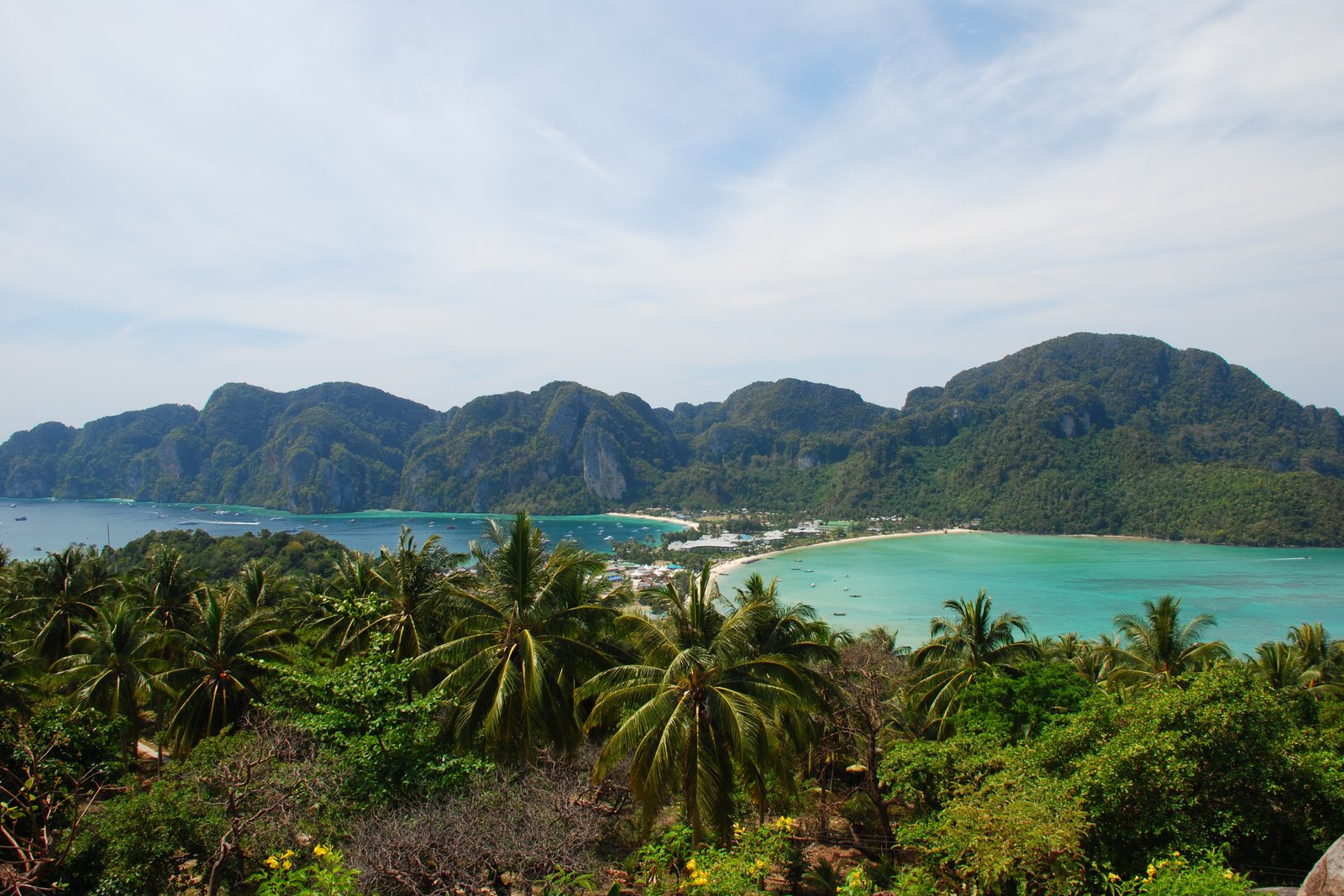
The climb to the viewpoint above the village starts in the lanes behind Tonsai and goes up hundreds of steps and steep paths, about twenty to thirty minutes at a steady pace; an entrance fee is charged on the way up. From the top the island pinches to a narrow sandy waist between two curved bays — Ton Sai Bay on one side, Loh Dalum on the other, limestone walls behind — the frame almost everyone knows from Phi Phi.
At sunrise it is nearly empty. The photographer goes up first, in the dark, and settles the angle that keeps both bays in the frame before you arrive; you climb in comfortable shoes and change at the top. Plan five minutes to cool down before the first frame, because the climb is real. It works again around sunset, with more company. For a proposal it is the obvious place, and the Phi Phi proposal page explains how to keep the surprise on a path with only one way up.
Ton Sai, Loh Dalum and the village
At sea level the isthmus has two faces. Ton Sai Bay, on the pier side, is the island's harbour: ferries, longtails, a working waterfront. Loh Dalum, on the other side, is very shallow, and at low tide the sea drains far out across the sand, leaving longtails sitting on wet flats that mirror the sky — a strong frame at first light, and a long walk to the water. At high tide it fills back into a calm bay.
Tonsai village is loud after dark and its lanes stay busy late, so the best frames there come early, before the shutters go up. With no cars on the island the lanes are easy with children, and a family session usually starts in the village and ends on a quiet beach a short longtail ride away.
Long Beach and Bamboo Island
Long Beach, a short longtail ride from Tonsai along the south coast, looks across the water to the cliffs of Phi Phi Leh — the frame that shows both islands at once, and a quiet one early in the morning. North of Phi Phi Don, Bamboo Island is a low island of white sand and clear water, a longer boat ride away. It lies inside the national park, so foreign visitors pay the park's entrance fee there, and it fills with tour boats by midday like everywhere else.
Phi Phi Leh and Pileh Lagoon
Phi Phi Leh, the smaller island, is uninhabited and almost all cliff, and it lies inside Hat Noppharat Thara–Mu Ko Phi Phi National Park. Pileh Lagoon is enclosed by sheer walls on almost every side, with emerald water inside and a narrow entrance the boats slide through. A longtail at first light finds it nearly empty, and the colour is strongest once the sun clears the cliffs and reaches the water. Swimming is allowed in the lagoon, so this is the place to get wet if the frame calls for it; the Phi Phi couples page shows how a session runs here.
The park sets the rules. Foreign visitors pay its entrance fee, and a professional shoot inside the park can need the park's permission, which the photographer clears in advance. Sunscreens containing oxybenzone, octinoxate, 4-MBC or butylparaben are banned in Thailand's marine national parks, so check the label before you pack.
Maya Bay and its rules
Maya Bay became famous through the film The Beach, and the crowds that followed damaged its reef so badly that the bay was closed for more than three years, from 2018 to the start of 2022. It reopened under strict national-park rules. Boats no longer enter the bay: they moor on the other side of the island, and visitors walk in on a boardwalk. Swimming is not allowed — blacktip reef sharks returned to the shallows while the bay was closed — and time on the beach is limited. The bay has also closed every year for about two months, 1 August to 30 September in 2025 and 2026; check the current dates, because they are set each year.
For a session this means Maya is a place you visit, not one you can stage. The first visitors of the day have the best chance of a clean frame of the sand and the cliffs behind it, and an early longtail from Phi Phi Don gets you there before the speedboats from Phuket. Keep the frames simple — the two of you walking at the water's edge, the cliffs, the turquoise — and do not plan a long session on the beach.
What to carry onto a longtail
A longtail is open to the sky and the spray, and it lands you in the water, not on a pier. Pack one dry bag for everything that has to stay dry: phone, ring, cards, a change of clothes. Wear what you can wade in and carry the shoes you want to be photographed in. Light fabrics that dry quickly beat linen that creases at the first splash, and a hat that is not tied on ends up in the sea. Phi Phi Leh is uninhabited, so bring water. The coloured cloth tied at the prow is an offering to the spirit believed to live in the boat: nobody steps on the prow, and a frame on board starts with asking the boatman.
The season on Phi Phi
From about November to April the Andaman is calm, the water at its clearest and the crossings easy. The weeks around Christmas and New Year are the busiest of the year and the day boats at their fullest, which makes the overnight stay even more worth it; book early. From about mid-February the heat builds to its April peak, and sessions move to the first and last hours of the day.
The southwest monsoon, from about May to October and usually wettest around September, brings swell that can cancel crossings and longtail trips at short notice. Leave a spare day before an onward flight, and do not book a session on the morning you leave. In return the cliffs are at their greenest, the bays emptier and the skies between showers dramatic. Rescheduling for bad weather is free for both sides. Drones are hard for a visitor, and the park adds its own rules: ask whether the photographer flies a registered drone rather than bringing your own.
Planning a Phi Phi Islands photoshoot
Stay a night if you possibly can, plan the session for the first light of the morning after you arrive, and keep the evening before as the spare. For a couple, see what a couples photoshoot covers: the sunrise viewpoint and an early longtail to the lagoon make one session, Long Beach at sunset another.
An hour covers the viewpoint well; two hours give the viewpoint and a longtail to Pileh Lagoon ahead of the day boats. Phi Phi combines easily with the mainland: Krabi and Phuket are the two ferry ports, and either makes a good second session on firm ground.
A photographer who works the islands knows when the first speedboats round the headland, how the tide is running at Loh Dalum and which beach the swell leaves alone. Read the destination page for the Phi Phi Islands, check how it works, and browse photographers online.
Want professional photos on the Phi Phi Islands?
Browse portfolios, compare packages, and book a verified local photographer in minutes.