Couples Photoshoot in Bangkok: the river at golden hour, the khlongs, Chinatown at night
A couples session in Bangkok works as a route, not a place. The city's best light comes on the river in the last two hours of the day, peaks for a few minutes as Wat Arun's lights come on, and then hands over to Chinatown, which only becomes photogenic once the neon and the food stalls are lit. Follow that order and one evening gives you water, a temple skyline and a street at night, each in its best hour. Start at midday and the same places look flat, hot and crowded.
The evening at a glance
Meet about two hours before sunset at a pier on the old-city side of the Chao Phraya. Spend the first hour on the water: a longtail into the khlongs of Thonburi and back out onto the river while the light turns gold. Be on the riverside on the Tha Tien side, facing Wat Arun, half an hour before the sun goes down, and stay until the temple is lit against a blue sky. Then cross to Chinatown — a short taxi ride, or two stops on the metro from the station by Wat Pho to Wat Mangkon — for Yaowarat Road after dark, and finish in the lanes of Talat Noi, which run down to the river.
Sunset in Bangkok moves by only about an hour across the year, so the photographer sets the start time by the date rather than the season. With the transfers, the route is two and a half to three hours: a walk with a boat in it.
Golden hour on the Chao Phraya
The river is Bangkok's main street, and a couple in front of it never looks posed for long. Express boats, ferries, longtails and barges behind a tug keep the background moving. In the late afternoon the sun drops towards the Thonburi bank, so frames taken from the old-city piers look into low, warm light with the boats as silhouettes, and frames taken from the water look back at the east bank lit from the side. Two people at the end of a pier with a ferry sliding past is the simplest picture in the city, and one of the best.
The piers are public and working: commuters come first, and the edge stays clear while a boat docks. The regular express boats wind down in the early evening, so later frames on the water come from the cross-river ferries or a boat arranged in advance; check the times on the day.
Into the khlongs of Thonburi
Across the river, a longtail turns off the Chao Phraya into the canals of Thonburi, and the city changes scale. Wooden houses on stilts line the water, with potted plants on the landings, washing on the rails and small temples whose steps run down into the canal. Under the eaves the light stays soft even when the river is bright, and late in the day people are home: someone cooking on a porch, children in the water. These are homes: the boat keeps moving, and nobody photographs into a window or a doorway.
For a couple the boat is the set: sitting close in the bow, the canal narrowing behind you, the wake catching the light. An hour on the canals is plenty for a session, and the longtail can bring you back to the old-city bank in time for sunset. Longtails are loud and fast on the open river, so hats and loose scarves stay in a bag until you are back on the pier.
Sunset facing Wat Arun from the Tha Tien side
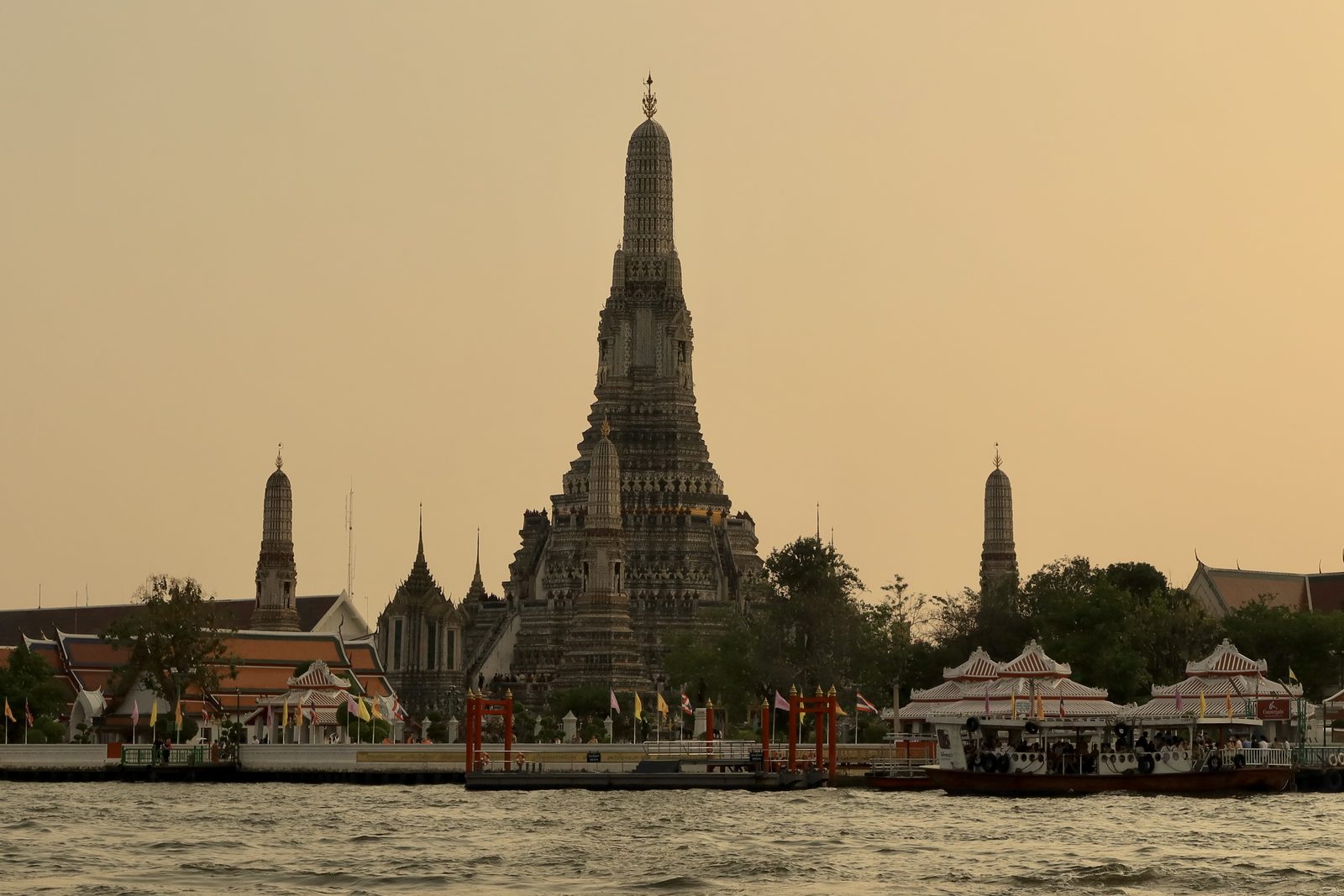
Wat Arun's porcelain-studded prang stands on the west bank, so in the evening the sun sets behind it and the frame is taken from across the river, on the Tha Tien side by Wat Pho. Two moments follow each other. First the temple goes dark against a coloured sky, which suits a silhouette of two people at the water's edge. Then, as the sky turns blue, the temple's lights come on, and for a few minutes the prang glows over dark water — the frame most couples come for. Be in place before sunset: the riverside fills, and the light that matters lasts minutes.
This is the stop that decides the route: running late on the canals costs the one picture that cannot be taken later. Wat Arun lit from the front is a morning visit to the temple itself, a few minutes across on the ferry from Tha Tien, with covered shoulders and knees; since January 2026 the temple has required photographers who work with costume-rental shops to complete its etiquette training, so check that it still applies.
Phra Sumen Fort: the quieter dusk
When the Tha Tien riverside is shoulder to shoulder, the riverside park at Phra Sumen Fort, at the northern end of the old city in Banglamphu, is the calm alternative. The fort is a whitewashed eighteenth-century bastion; the park around it is lawn and river, and in the evening it belongs to joggers and people sitting by the water rather than to tour groups. The white walls hold the last warm light, and the river behind gives the dusk sky room. It is also where a proposal in Bangkok can happen without an audience. Chinatown is a taxi ride away.
Yaowarat Road after dark
Yaowarat is the second half of the evening and needs the dark to work. Neon signs stack over the street, gold shops glow, and food stalls spread across the kerbs, the smoke from the grills catching the light. For a couple it is the opposite of the river — close, loud, warm, with strangers in the background — which is exactly what makes the frames read as Bangkok at night. The photographer works from the pavements and the side lanes; the traffic never stops, and nobody poses in the road.
Use a quieter side street for close portraits and the main road for wide frames with the signs behind you. Two people sharing food at a stall make a better picture than two people standing still; ask before photographing a stall up close, and buy from it.
Talat Noi and the river for the finish
A short walk towards the river, Talat Noi is the quiet end of Chinatown: lanes of old shophouses, workshops with engine parts stacked by the door, murals and a Chinese shrine near the water. At night it is dim and intimate, lit by doorways, which suits slower, closer frames after the noise of Yaowarat. People live here and work late; voices stay low, and a workshop is photographed only after a yes.
The lanes end at the river, and the skyline is the finish: towers lit along both banks, boats crossing with their lights on. A session that began on the water in gold light ends on the water in the dark.
What changes for a couple
Temple rules apply to both of you. At any temple stop, shoulders and knees are covered for both, shoes come off before entering a hall, feet never point at a Buddha image or a monk, and a woman does not touch a monk or hand him anything directly. Kisses and lifts belong outside the temple walls: on the pier, in the park, in a Chinatown lane. A light shirt or a sarong in a bag solves the dress rule in a minute, and shoes that slip off save time at every door.
Wear linen and cotton in colours that hold up in warm light and under neon alike; Bangkok is humid even after dark, so avoid anything that shows sweat, and bring water.
The seasons on the river
November to February is the kindest season for an evening outdoors: cool, dry air, clear skies at sunset and the most comfortable walking of the year. It is also the busiest, around Christmas and New Year above all, so book early. From March the heat builds to its peak in April; the route still works because it starts late in the day. Songkran, the Thai New Year, is a public holiday from 13 to 15 April, when water is thrown in the streets: plan the session away from it, or protect the gear and join in.
The rains run from about mid-May to mid-October and usually arrive as a heavy afternoon downpour rather than a grey day. If it hits during the river hour, wait it out under cover: the hour after the rain is a gift to the night half, with wet tarmac doubling every sign on Yaowarat and the air washed clean. Loy Krathong, on the full moon of the twelfth Thai lunar month, usually in November, fills the riverbanks with people floating small offerings: check the date for your year, and build the evening around it or keep away from the river.
Planning a couples photoshoot in Bangkok
The river with Wat Arun alone fits into about an hour and a half, Chinatown at night into an hour. The morning version is a different session: Wat Pho at opening time, before the tour groups and the heat, then the river in soft early light. Both are a couples session in Bangkok; see what a couples photoshoot usually covers.
For honeymooners, Bangkok is usually the first or the last night of the trip, and the last works better: jet lag shows in the eyes, so leave a day after a long-haul flight. If the city is one stop on a longer route, read what a honeymoon photoshoot involves.
A photographer who knows the river knows which pier gives a clean line to Wat Arun, when the boats stop and where to wait out a downpour. The photographer confirms within 24 hours, and rescheduling for weather is free for both sides. Read the destination page for Bangkok, check how it works, and browse photographers online.
Want professional photos in Bangkok?
Browse portfolios, compare packages, and book a verified local photographer in minutes.